
Introduction
A textile ecommerce website in Surat usually has to do two jobs at once: sell full catalogue sets and bulk fabric to resellers, and sell single sarees, suits and dress materials to shoppers. The way to build one that works is to give each buyer type its own path through the same catalogue, with trade accounts and minimum order rules for wholesale buyers, clean variants and photos for retail buyers, and the seller details Indian e-commerce rules ask you to display.
Many textile traders already sell through agents and marketplaces. A website adds is a place you own, where a reseller in another state can reorder a catalogue at 11 pm and a shopper can find one specific saree on Google. This guide covers how we plan that kind of store, what to decide before design starts, and where textile sites usually go wrong.
Do you sell wholesale, retail, or both?
Answer this before anything else, because it decides almost every later choice. A wholesale-first site is really an ordering tool for people who already know you. A retail-first site is a shop window for strangers. A mixed site has to keep both happy without confusing either.
If you trade from Surat, chances are you sell some designs as a set (a catalogue of several designs sold together), some fabric by the metre or by the roll, and some finished pieces one at a time. Write down which products are sold which way. That list becomes your catalogue structure.
| Question | Wholesale buyer (reseller, boutique) | Retail buyer (shopper) |
|---|---|---|
| What they buy | Full catalogue sets, bulk fabric, repeat orders | One saree, suit or dress material |
| How they find you | Agent, referral, past order, direct link | Google search, Instagram, marketplace |
| What they need to see | Set contents, minimum quantity, dispatch time, GST invoice | Clear photos, colour, fabric, size or length, returns policy |
| Who sees trade terms | Only after their account is approved | Never |
| How they pay | Online payment or agreed trade terms | Online payment at checkout |
How should you structure a textile catalogue?
Group products the way your buyers think, not the way your godown is arranged. For sarees and dress materials that usually means fabric (georgette, chiffon, cotton, silk blends), occasion (wedding, festive, daily wear) and work type (embroidery, print, zari). Each product should sit in one main category, with filters doing the rest.
For catalogue sets, create the set as one product and list every design inside it, each with its own photo. A reseller wants to know exactly which designs and colours arrive in the box. For fabric sold by the metre, set the quantity step and minimum length on the product so the cart cannot accept an order you cannot cut.
Variants deserve care. A saree that comes in six colours is one product with six colour variants, not six separate products with near-identical text. If your range runs into thousands of variants, the platform choice matters, and we compared the limits in WooCommerce vs Shopify for thousands of product variants.
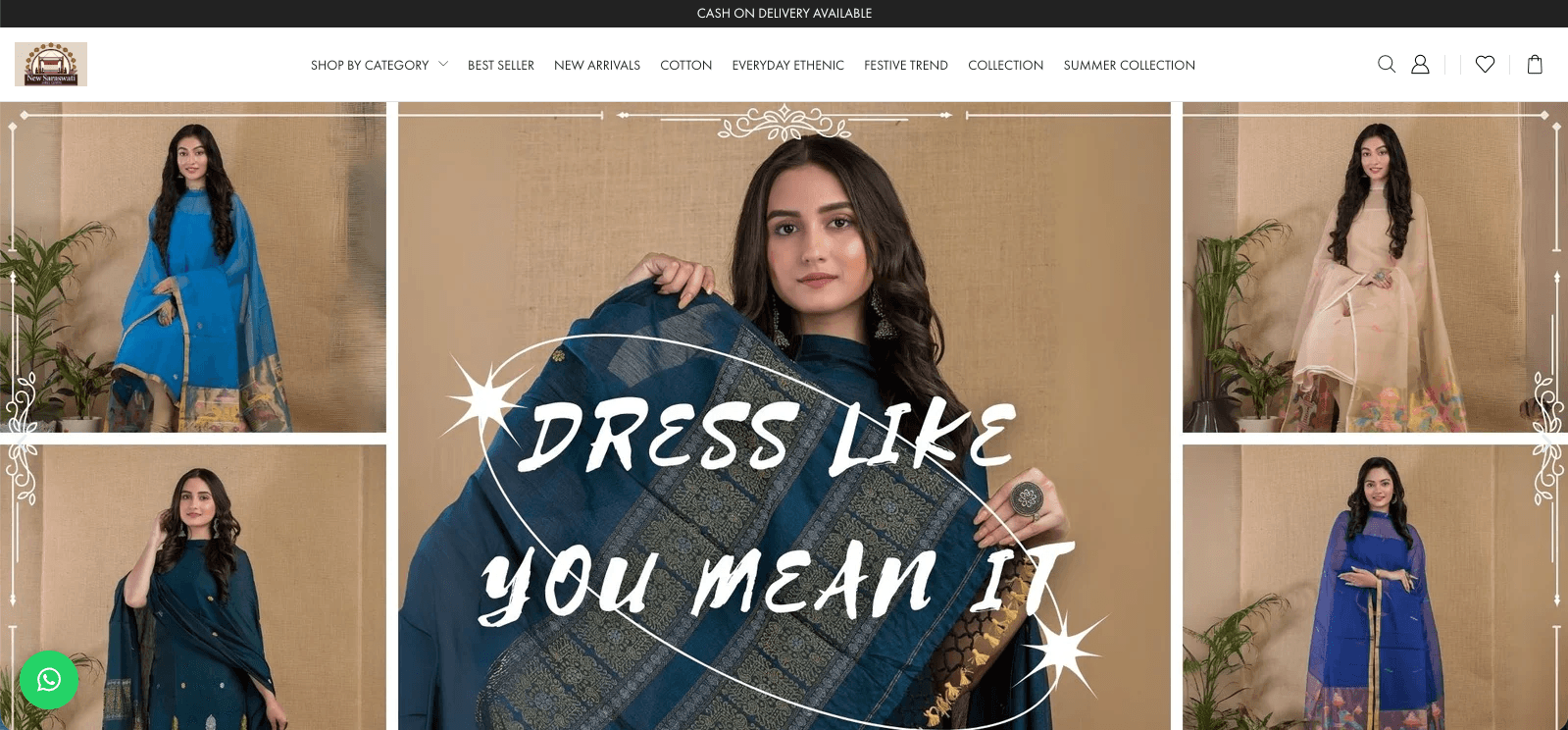
We followed the same principle for New Saraswati Saree Centre, a WooCommerce store whose catalogue of 40+ handwoven sarees is organised by weave type (cotton, muslin, paithani) because that is how its existing customers already chose sarees, with festive collection pages for Diwali, Navratri and Durga Puja as the main discovery paths.
How do you keep wholesale terms away from retail shoppers?
The common approach is a trade account. A reseller registers with their business name, GSTIN and city, you approve them by hand, and only then do they see trade terms, set quantities and the wholesale order form. Shoppers who never log in see the normal retail shop.
Practical rules that save arguments later:
- Set a minimum order quantity per product or per cart for trade accounts, and show it on the product page before they add to cart.
- Show stock at the set level for catalogues, so nobody orders a set that is missing two designs.
- Give trade buyers a quick reorder button from their past orders.
- Capture the buyer's GSTIN at registration and print it on the tax invoice automatically.
- Keep one stock count for both channels, so a retail sale and a wholesale order cannot both claim the last piece.
Both WooCommerce and Shopify can be set up this way, usually with extensions or apps. Which one suits you depends on how custom your trade rules are. If your rules are unusual, a custom build may be simpler than bending a plugin. Our ecommerce development service starts by mapping those rules before any platform is picked.
What do product pages need for sarees and fabric?
A website cannot let buyers touch the fabric, so the product page has to work harder than a showroom.
- Photos in daylight, with the full drape, the pallu, the border and a close-up of the weave or embroidery. Add one photo next to something for scale.
- Colour named honestly, with a note that screens vary. Colour complaints are hard to settle if the page never named the colour clearly.
- Fabric and care: material, blouse piece included or not, length, width for fabric by the metre, wash care.
- Dispatch time for each product, especially if some designs are made to order.
- Short video of the fabric moving, if you can shoot it. It answers the "how does it fall" question that photos cannot.
We wrote about similar choices for another textile city in selling Banarasi sarees online from Varanasi.
Which legal details must an Indian textile store show?
If you sell your own stock online, India's Consumer Protection (E-Commerce) Rules, 2020 apply to you, not only to big marketplaces. The rules cover marketplace and inventory models, including single-brand retailers. Among other things, they ask every e-commerce entity to:
- Display its legal name, the geographic address of its headquarters and all branches, website details, and contact details such as email and customer care numbers, in a clear and accessible place (Rule 4(2)).
- Appoint a grievance officer, display their name, contact details and designation, acknowledge a complaint within 48 hours and resolve it within one month of receiving it (Rules 4(4) and 4(5)).
- Record a customer's consent only through an explicit action, not through pre-ticked checkboxes (Rule 4(9)).
- For inventory sellers, show accurate information on returns, refunds, exchange, delivery and shipment, the cost of return shipping and payment methods (Rule 7(1)).
On the site, that usually means a proper contact page, a grievance officer block in the footer or policy pages, an unticked newsletter box at checkout, and a returns policy that states who pays for return shipping on a colour or damage complaint. This is a summary, not legal advice.
Free quote · reply within 24 hours
Planning an online store, or fixing one?
Tell us what you sell and where it's stuck. You get a fixed written quote within 24 hours.
How do Surat textile products show up on Google Shopping?
Free product listings on Google can bring retail shoppers straight to a product page. Clothing has stricter feed rules than most categories. Google's Merchant Center product data specification says color, gender and age_group are required for free listings for all Apparel & Accessories products, and asks that variants of one product share the same item_group_id, with colour and size submitted per variant.
For a saree catalogue, that means each colour variant needs a real colour name (the specification says not to use values such as "multicolor" or "see image"), gender set to female, and age group set to adult. If products later go missing from Google, our guide on products not showing on Google covers the usual causes.
What should you plan for orders, payments and dispatch?
Retail shoppers expect to pay online at checkout and get an order confirmation and tracking by email or SMS. Wholesale buyers may pay online too, or on terms you agree with established accounts. Decide which payment options each buyer type sees before the build, not after launch.
Plan dispatch the same way. Sets ship in bigger parcels with different courier rates and timelines from a single saree. Your shipping rules should know the difference, and your order emails should state the expected dispatch date for made-to-order designs. Make the order flow end on a clear "order confirmed" page on your own site, so buyers know the order is placed without having to message you.
Where do textile websites usually go wrong?
- Uploading a marketplace catalogue as it is. Marketplace titles stuffed with keywords read badly on your own site and duplicate text you do not control.
- One product per colour. It clutters the catalogue and splits reviews across copies.
- Trade terms visible to everyone. Retail shoppers get confused and resellers lose trust.
- No dispatch times. A buyer waiting for a made-to-order set with no date will cancel.
Frequently asked questions
Can one website handle both wholesale and retail?
Yes. The usual setup is one catalogue with trade accounts that you approve by hand. Approved resellers see minimum quantities, catalogue sets and their own order form, while everyone else sees the normal retail shop. Stock stays in one place for both.
Should I use WooCommerce or Shopify for a textile store?
Both can work. WooCommerce gives more control over custom trade rules and catalogue sets, while Shopify is simpler to run day to day. The deciding factors are how many variants you have, how unusual your wholesale rules are, and who will manage the site after launch.
Do I need a grievance officer for a small online store?
The Consumer Protection (E-Commerce) Rules, 2020 ask every e-commerce entity to appoint one and display their details on the platform, with complaints acknowledged within 48 hours and resolved within one month. Check with your legal adviser how the rules apply to your business.
Can I sell to resellers outside Gujarat through the website?
Yes. A website works the same for a reseller in any state, and trade accounts let you approve buyers wherever they are. Make sure your GST invoicing and shipping rules are set up for interstate orders before you open trade registration.
Conclusion
If you sell both catalogue sets and single pieces, build one textile ecommerce website with two clear paths: approved trade accounts with minimum quantities and quick reorders for resellers, and a clean retail shop with honest photos, proper variants and a Google-ready product feed for shoppers. Put the seller and grievance details the e-commerce rules ask for in place before launch, not after the first complaint. We have built textile and ethnic wear stores among 100+ projects delivered, and we can plan yours around how you actually sell. Message us on WhatsApp at +91 73482 28167 and you get a fixed written quote within one working day.
Free quote · reply within 24 hours
Want a fixed price for your project?
Tell us what you sell and where it's stuck. You get a fixed written quote within 24 hours.
Keep reading on E-commerce
- Jewellery Ecommerce Website in Jaipur: Build One That SellsHow to build a jewellery ecommerce website for a Jaipur business: hallmark proof, product photos, clear price breakdowns, safe checkout and selling abroad.
- WooCommerce vs Shopify for Thousands of Product VariantsShopify caps each product at 2,048 variants; WooCommerce dropdowns change after 30. How each platform copes with huge variant counts and which to pick.
- Shopify Store for Australia: GST, Afterpay & Privacy ActSetting up a Shopify store for Australian shoppers: GST-inclusive prices, Afterpay, clear shipping, and Privacy Act checks before you go live.