
Introduction
A Banarasi saree website lets Varanasi weavers and retailers sell under their own brand, show weave and zari detail buyers need before they buy, and take orders without relying only on Instagram DMs or a marketplace listing. Banaras Brocades and Sarees hold a registered Geographical Indication in India (application 99, certificate dated 4 September 2009), so authentic origin and craftsmanship are part of what customers search for online.
This guide covers when Instagram-only selling stops working, what to put on product and collection pages, how festive seasons fit ecommerce, and which store features matter for handwoven textiles. We work remotely from Lucknow and Mumbai; we do not have a Varanasi office.
Why Banarasi sellers need their own website
Instagram and WhatsApp are where many Varanasi shops start. That works until a buyer asks for size variants, COD versus UPI, a gift wrap note for Diwali, or a written invoice — and you are juggling screenshots in a chat thread. A website turns that into product pages, a cart and a checkout you control.
Buyers also search Google for Banarasi sarees by weave, occasion and city. Marketplace listings put you next to every other seller. Your own store lets you explain the craft, show close-ups of the border and pallu, and keep the customer relationship after the sale.
The Varanasi district administration describes Banaras brocade sarees as finely woven silk with intricate zari, Mughal-inspired motifs such as kalga and bel, and work done on conventional Banaras handloom Jacquard looms. That story belongs on your product pages, not buried in a caption.
Instagram-only vs own website vs marketplace
Use this comparison when you decide where to invest next. Many shops keep Instagram for discovery and add a website for checkout.
| Factor | Instagram-only | Own website | Marketplace |
|---|---|---|---|
| Brand control | Limited to profile and posts | Full control of layout and story | Shared template with other sellers |
| Product detail | Captions and Stories; hard to search later | Dedicated pages with filters and variants | Fields set by the platform |
| Checkout | DMs and WhatsApp payments | Cart, UPI, cards, wallets, COD if you offer it | Platform checkout and rules |
| Fees and ranking | No listing fee; algorithm decides reach | You pay hosting and payment gateway costs | Commission and ads often required for visibility |
| Customer data | Mostly in chats | Orders and emails stay with you | Held largely by the marketplace |
| Best for | New shops testing demand | Sellers who want repeat buyers and festive drops | Volume sellers who accept platform rules |
If you already get enquiries on Instagram but lose them when payment or size questions appear, a store is usually the next step — not a bigger ad budget on someone else's platform.
What the GI registration means for your product pages
Intellectual Property India lists Banaras Brocades and Sarees as a registered Geographical Indication (application number 99). The filing date is 4 July 2007; the certificate date is 4 September 2009; registration is valid through 3 July 2027. Goods sit under classes 23, 24, 25 and 26 as handicraft, with the geographical area recorded as Uttar Pradesh. See the official GI application details.
You do not need to put legal jargon on every page. You do need accurate product copy: weave type, silk or blend, zari work, border and pallu detail, and honest origin language that matches what you actually sell. The official GI record is useful background for customers who care about authenticity, and for you when planning category names and filters.
Link the GI story from an About or Craft page rather than stuffing every listing. Keep SKUs clear so a buyer who saw a saree in your loft can find the same piece online.
Product pages that sell handwoven sarees
WooCommerce's product documentation stresses that a name and price alone are rarely enough: categories, attributes, variations, images, dimensions and reviews all affect how shoppable a catalogue feels. For Banarasi and other handwoven sarees, that usually means:
- Attributes buyers filter by — weave (for example jamdani, tanchoi, tissue), fabric, colour family, occasion (wedding, festive, daily wear) and length where relevant.
- Variable products — blouse piece options, blouse fabric, or pre-stitched versus unstitched, each with its own stock if you track inventory.
- Photography — full drape, border close-up, pallu detail and a flat lay. One lifestyle shot helps; three detail shots build trust for high-ticket textiles.
- Care and shipping notes — dry-clean guidance, folding for courier, and expected dispatch time during peak festive weeks.
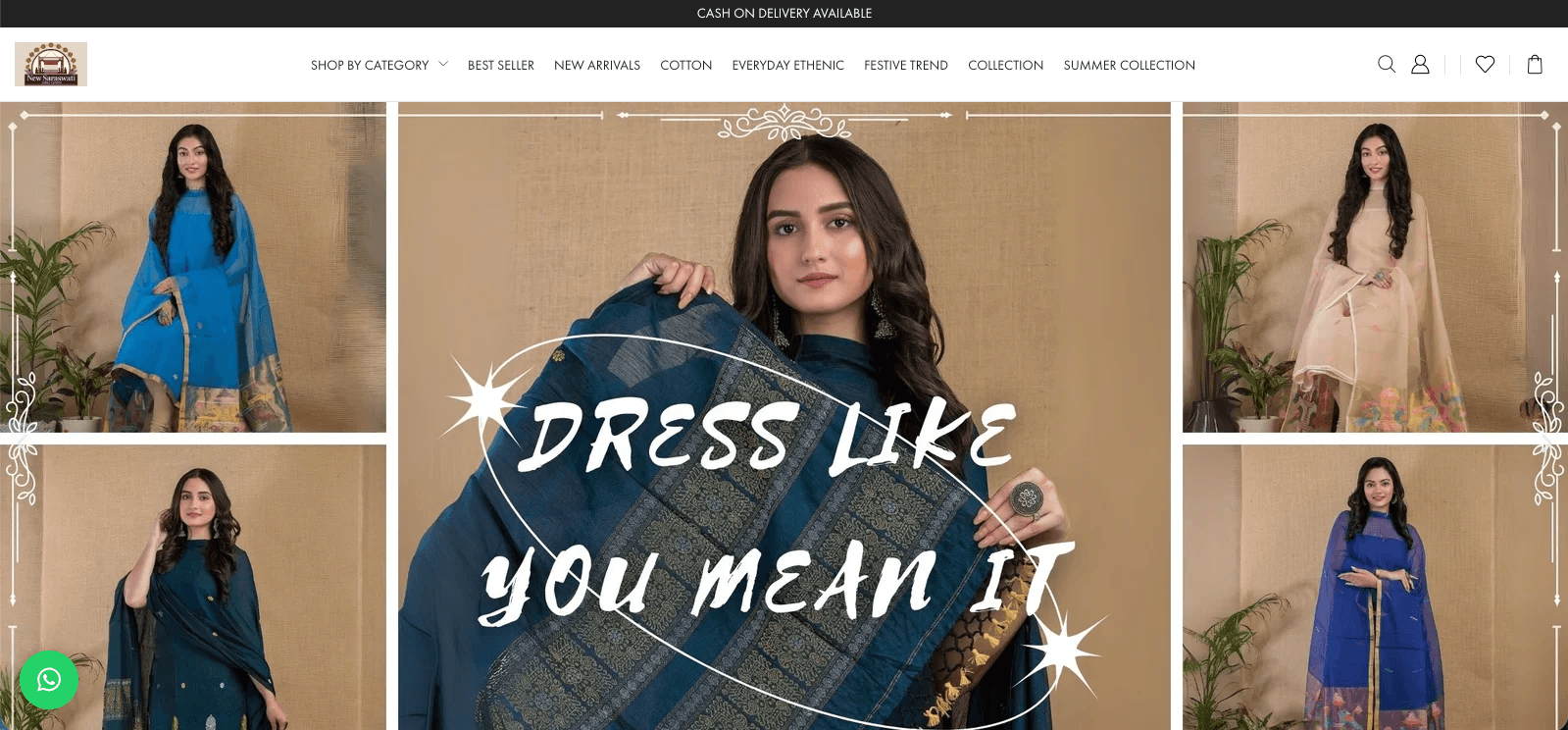
If you run WooCommerce, categories and attributes also drive the shop filters customers use on mobile. That is the same pattern we used on the New Saraswati Saree Centre store: a catalogue structured around weave types customers already understand, plus filters so a 40+ product range stays easy to browse.
Festive collection pages for Diwali, Navratri and more
Banarasi demand peaks around weddings and festivals. A flat product grid does not match how people shop in those weeks. Dedicated collection pages for Diwali, Navratri, Durga Puja or wedding season give you:
- A landing URL you can share in Stories and WhatsApp statuses.
- Curated picks (heavy bridal vs lighter festive wear) instead of making buyers dig through the whole catalogue.
- Seasonal search landing pages you can improve each year without rebuilding the store.
On New Saraswati Saree Centre we built festive collection pages for Diwali, Navratri and Durga Puja as primary discovery paths, not only filter tags, because that matched how their offline customers already shopped. The same idea applies to a Banarasi-focused catalogue in Varanasi: lead with the occasion, then the weave.
Payments, wishlist and mobile checkout
Indian buyers expect UPI, cards, wallets and often net banking. A multi-gateway setup reduces abandoned carts when someone's preferred method is missing. Wishlist and compare tools help when a family is choosing between two borders on a phone — common behaviour for saree purchases.
Free shipping thresholds and clear courier messaging matter more than clever homepage animations. Mobile layout is non-negotiable: most Instagram traffic arrives on a phone, and a slow or awkward checkout sends them back to DMs. If your WooCommerce store is already live but sluggish, our WooCommerce speed optimisation guide covers the technical checks before you redesign everything.
WooCommerce or Shopify for a Banarasi store?
Both can sell sarees well. The choice depends on how you want to manage catalogue complexity, plugins versus apps, and who will update stock after each loom delivery. Our WooCommerce vs Shopify for India comparison walks through that decision without treating either as a default.
In short: WooCommerce suits teams who already use WordPress and want deep control over product data and hosting. Shopify suits teams who want a hosted admin and a simpler ops load. For either platform, plan attributes and festive collections before you import hundreds of SKUs.
How we built a handwoven textile store
New Saraswati Saree Centre came to us as a trusted offline handwoven textile retailer with no digital sales channel. We built a WooCommerce store with 40+ products across cotton, muslin and paithani, multi-gateway payments, wishlist and comparison, free shipping messaging, and festive collection pages for Diwali, Navratri and Durga Puja. The live site is newsaraswatisareecentre.in.
That project is not a Banarasi GI catalogue, but the ecommerce pattern is the same: organise by how customers already think about weave and occasion, then make checkout work on a phone. Across 100+ projects delivered, that is the approach we take for textile and ecommerce builds from our Lucknow and Mumbai offices — including remote work for shops in other cities such as Varanasi.
If you want the same kind of store built for your Banarasi catalogue, see our ecommerce web development services. Teams near our Lucknow base can also start from the ecommerce development company in Lucknow page; we still deliver remote builds for Varanasi sellers.
Frequently asked questions
Do I need a website if Instagram sales are already coming in?
Yes, once you are losing orders to payment confusion, size questions or festival rush. Instagram remains a strong discovery channel; the website becomes the place where product detail and checkout live. Many sellers keep both.
Can I sell Banarasi sarees on my own site and still use WhatsApp?
Yes. Use the site for catalogue and payment, and WhatsApp for custom blouse stitching questions or wholesale. Put the WhatsApp number on product pages so buyers who prefer chat still land on a tracked product URL first.
Should I mention the GI tag on every product?
Mention authenticity and origin where it is true, and keep a Craft or About page that links to the official GI context. Do not label a saree as Banaras Brocades and Sarees GI if it was not made in the registered tradition and area. Honest product copy protects both you and the buyer.
WooCommerce or Shopify for a small Varanasi shop?
Either works. Choose based on who will update products weekly and how many variants you need. Read the India-focused comparison linked above, then pick the platform you can maintain during wedding season — not the one with the flashiest demo.
Do you have an office in Varanasi?
No. NextGen Fusion's offices are in Lucknow and Mumbai. We design and build ecommerce sites remotely for clients across India and abroad, including textile retailers.
Conclusion
A Banarasi saree website is less about a pretty homepage and more about clear product data, festive collections, reliable Indian payments and a mobile checkout that does not send buyers back to DMs. Start with the catalogue structure, then choose WooCommerce or Shopify and launch with a few strong festive pages rather than waiting for a perfect 500-SKU import. Message us on WhatsApp at +91 73482 28167 and you get a fixed written quote within one working day.