
Introduction
If you run a Singapore business and a local quote did not fit the budget, an Indian web team is an obvious next call. It can work well. It also has trade-offs that Singapore businesses in particular should know about before paying a deposit, and one of them, the Productivity Solutions Grant, can decide the whole question.
We are an Indian team, with offices in Lucknow and Mumbai and no office in Singapore, so this is written from the supplier's side.
The short version
Hiring in India gets you a rate set for an Indian cost base and an afternoon overlap with Singapore. You give up mornings, meetings across a table and, if you were counting on it, the PSG grant. Everything below is detail on those points.
How quotes work
We do not publish prices, because a number on a page is a guess about a project we have not heard yet. An Indian team's rates are set for an Indian cost base, so a comparable scope usually costs less than a local agency, but compare scope line by line rather than totals. Message us on WhatsApp +91 73482 28167 and you get one fixed written quote in rupees, with one delivery window, within one working day.
What decides the price, and what recurs after launch, is on our cost guide for Singapore.
Time zones: afternoons, not mornings
Singapore is two and a half hours ahead of India all year. Our team works 10:00–19:00 India time, Monday to Saturday, which is 12:30–21:30 in Singapore.
That covers every Singapore afternoon and early evening. It does not cover the morning: a question sent at 9am waits until our day starts. The projects that work around this run on written updates, so a morning in Singapore is spent reading yesterday's progress rather than waiting for a call.
What you give up
- The Productivity Solutions Grant. PSG covers pre-approved solutions from vendors registered for it. We are not a PSG vendor, and most Indian teams are not. If the grant decides your budget, you need a Singapore-registered vendor on the PSG list, and it is better to know that before the first call.
- Meetings in person. Everything runs on video, WhatsApp and email.
- The Google Maps pack. Appearing in "near me" results needs a Google Business Profile at a real Singapore address. An overseas agency can help you set up your own, but cannot put you there with its address.
Contracts, currency, GST and domains
We quote and invoice in rupees, so your accountant can compare the invoice with a local one on the same footing.
Singapore GST is 9%. How it applies when you buy services from a supplier outside Singapore depends on your company's GST registration, so ask your accountant before comparing an Indian quote with a local one.
A .sg domain needs a Singapore administrative contact, so your company registers it, not the developer. That is how it should be anyway: the domain, hosting, payment gateway and analytics accounts should all be in your company's name from day one, whoever you hire and wherever they are.
How to check an Indian agency before you pay a deposit
- Ask for live sites. Open them on your phone on mobile data, not on office wifi.
- Ask who writes the code, and whether that person will still be answering in month six.
- Ask for the support plan in writing, with a price. Most of the businesses that come to us do so because a previous developer stopped replying after the final payment.
- Send a message at 2pm Singapore time. How fast the reply comes before you have paid is the best predictor of after.
- Ask whose name the accounts are in. If it is not yours, walk away.
What we have built that is closest to Singapore
We have not yet built for a Singapore-registered company. The closest work is maritime, which matters in one of the world's largest bunkering ports.
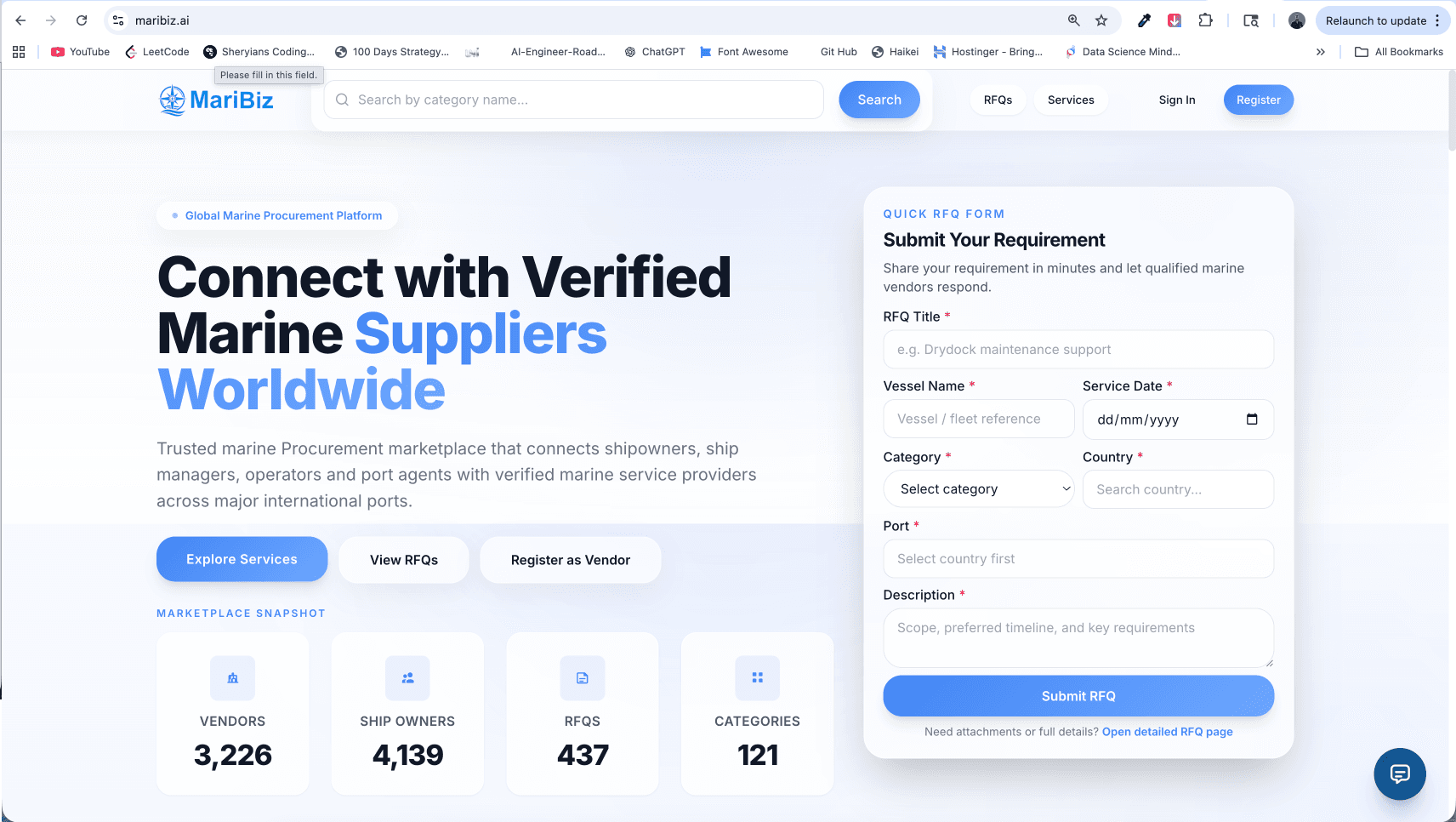
MariBiz.ai is a marine procurement marketplace with more than 3,226 verified vendors, a request-for-quote engine and port-by-port search. Cleanship, a marine cleaning company whose crews mobilise to ports including Singapore, runs on a site with a landing page for every service at every port. For startups, NEXTmentor is a Next.js course platform with payments, verifiable certificates and a referral programme.
For more, see website development for Singapore businesses.
Conclusion
An Indian team suits a Singapore business that does not need PSG, is comfortable with afternoon calls and written updates, and wants a fixed price after a short conversation. If that is you, message us with what the site has to do and we will reply with a written scope and a price within one working day.