
Introduction
Hiring a web development team in India from the USA works well when your project can run on written feedback instead of daily live meetings, and when the contract puts the code and every account in your company's name. India is 9.5 to 10.5 hours ahead of New York, depending on the season, so most of the work happens while you sleep and the live overlap is your early morning. Get those two things right and the distance matters far less than most US buyers expect.
We are NextGen Fusion, a web development team working remotely from Lucknow and Mumbai with clients abroad, including businesses in the US. We have no office in the US. Below is how our working day lines up with US time zones, what a US company should put in the contract, the tax form your accounts team may ask about, and the cases where a team in India is the wrong choice.
How does the Indian working day line up with US time zones?
Our team works Monday to Saturday, 10:00 to 19:00 India Standard Time, as set out on our page for international clients. The gap with the US moves when US clocks change: New York goes from Eastern Daylight Time (UTC−4) to Eastern Standard Time (UTC−5) on 1 November 2026 and back on 14 March 2027, according to timeanddate's New York time zone page.
| US time zone | US winter (standard time) | US summer (daylight time) |
|---|---|---|
| Eastern (New York) | 23:30–08:30 EST | 00:30–09:30 EDT |
| Pacific (San Francisco) | 20:30–05:30 PST | 21:30–06:30 PDT |
In US winter our day starts at 23:30 Eastern the evening before; in US summer it starts just after midnight. On the East Coast that leaves live overlap in your early morning, until 8:30 a.m. in winter or 9:30 a.m. in summer. On the West Coast there is almost none, so more of the work happens in writing.
What does a working day look like on a US project?
Treat the time gap as an overnight shift rather than a problem to work around. The rhythm that works for our international clients looks like this:
- Before you log off, you leave feedback on the staging site in one place: a shared document, a ticket board or annotated screenshots.
- While you sleep, we work through the list during our day.
- When you start your morning, the changes are on staging with a short written note: what changed, what didn't and any question that blocks the next step.
- If something needs a conversation, we book a video call in your morning, while our day is still running.
The catch is that the loop runs once a day. A question that only you can answer waits for your morning, so a vague brief loses a full day on every round trip. Answer blocking questions first, batch the rest, and name one person on your side who signs off.
What should a US company put in the contract?
Copyright in the code
This is the clause worth reading twice. The US Copyright Office's Circular 30 on works made for hire explains that the author of a work is ordinarily the person who actually created it. A commissioned work only counts as "made for hire", with the commissioning party as author and owner, if it falls into one of nine categories listed in the Copyright Act and both parties expressly agree to it in a signed written document. Websites and software are not named among those nine categories.
So don't rely on a "work for hire" line on its own. Ask for a written assignment of copyright in the code and design to your company, plus a list of the third-party and open-source components used and their licences. Have your own lawyer check the wording; this is a checklist from the supplier's side, not legal advice.
Accounts in your company's name
Open the domain, hosting, code repository, analytics and payment gateway accounts yourself, in your company's name, and give the developer access. That is how we work with every international client: nothing has to be handed back if you ever stop working with us. The payment gateway in particular should carry your business and bank details, never a developer's.
Confidentiality, scope and what happens after launch
If you are sharing anything sensitive before the project starts, ask for an NDA first; we are happy to sign one. The written quote should then set out the scope, the milestones and what happens after launch, so nobody has to remember what was said on a call.
Which tax form will your accounts team ask about?
The IRS describes Form W-8BEN-E, the "Certificate of Status of Beneficial Owner for United States Tax Withholding and Reporting (Entities)", as the form foreign entities use to document their status for US tax withholding and reporting purposes.
If your accounts team needs it, raise it when you sign, not when the first invoice arrives. What your company needs from the form, and whether it needs it at all, is a question for your accountant. We don't give US tax advice.
How do you check an Indian team from the US before you sign?
- Test them in your time zone. Send your enquiry at the end of your working day and see what is waiting when you start the next morning. That is the rhythm the whole project will run on.
- Click through their delivered work. Open live sites and case studies yourself instead of relying on screenshots, and check how they load on a phone.
- Find out who you will be talking to. Ask whether the person scoping the job is the one who writes the code. With us there are no account managers in between: enquiries go straight to the developers who would run the project.
- Get support after launch in writing. Sites need updates and fixes long after they go live. Our website maintenance service is run by the same people who built the site.
- Ask how they handle accessibility. We design and build to WCAG 2.2 AA. Ask any team, in any country, how they test colour contrast, keyboard navigation, form labels and image alt text.
When is a team in India the right call, and when isn't it?
| Your situation | Remote team in India | Team in your own time zone |
|---|---|---|
| Feedback can be written down and batched once a day | Good fit: changes land overnight | Good fit: changes land the same day |
| You want daily live stand-ups through the US afternoon | Poor fit: our day ends by 9:30 a.m. Eastern | Better fit |
| You need workshops or on-site visits at short notice | Not possible: we have no US office | Possible |
| Your sector has rules on where data may be accessed from | Check with your compliance adviser first | Check as well |
| You have a clear brief and one person who signs off | Good fit | Good fit |
If most of your rows land in the left-hand column, a team in India is a sensible choice. If you need someone in the room or on a call every afternoon, hire closer to home.
What have we built that you can click through?
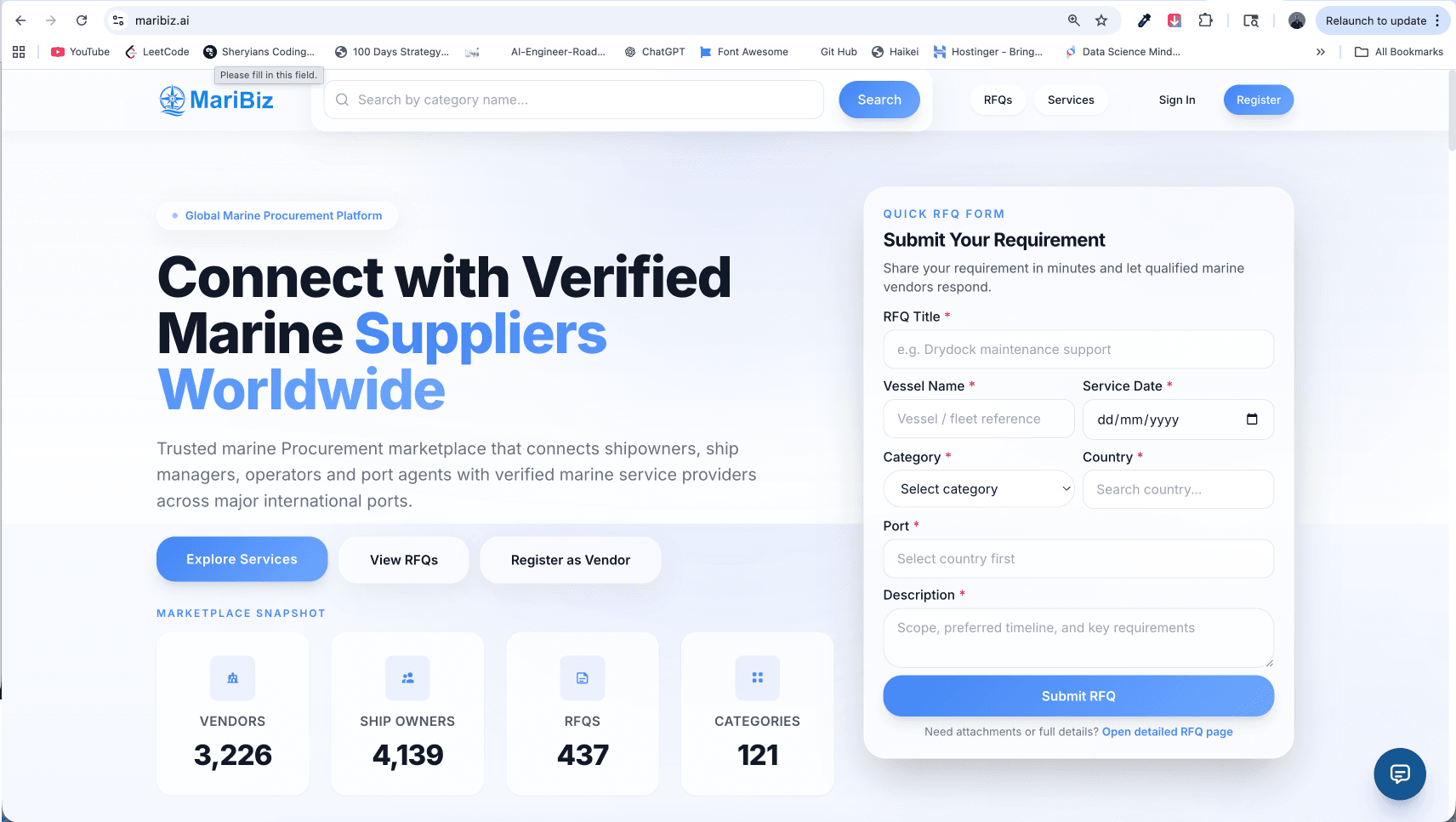
We don't have a published US case study yet, and we'd rather say so than stretch something to fit. The closest match in scale is MariBiz.ai, a global B2B marine procurement marketplace connecting 3,226+ vendors with shipowners across 121 service categories. It is built around a request-for-quote engine with vendor verification, real-time messaging and port-based search, using React, Node.js, TypeScript, WebSockets and PostgreSQL.
Most US small-business projects are simpler than that. If you are still choosing a platform, our comparison of Next.js and WordPress for a business website sets out when each one makes sense.
Frequently asked questions
Do you have an office or staff in the US?
No. We are a remote team in Lucknow and Mumbai, India, and we work with US clients by email, WhatsApp and video calls booked in your morning. We don't claim a US address.
How do you handle the time difference with the US?
Our day runs 10:00 to 19:00 IST, which ends at 8:30 a.m. Eastern in US winter and 9:30 a.m. in US summer. Projects run on written feedback: you leave notes before you log off and find the changes on staging in the morning, with calls booked in your morning when they are needed.
Will my company own the code?
It should, and it should be in writing. The Copyright Office's rules on works made for hire are narrower than many people assume, so ask for a written copyright assignment to your company and have your lawyer check it. Keep the domain, hosting, repository and payment accounts in your company's name from the first day.
What is Form W-8BEN-E and do I need it?
It is the IRS form foreign entities use to document their status for US tax withholding and reporting. Whether your company needs one from an Indian supplier is for your accountant to decide, so ask early and request it when you sign.
What do you need from me for a quote?
A short written brief: what the business does, who buys from it, what the site or app has to do, the platform if you have picked one, and whether the content is ready. We reply with the scope, the milestones and a fixed written quote.
Conclusion
Hire a web development team in India from the USA when your project can run on written, once-a-day feedback, the code is assigned to your company in writing and every account is in your name; if you need live collaboration through the US afternoon, a team in your own time zone will suit you better. If the first case sounds like you, talk to a team with 100+ projects delivered and no account managers in between. Message us on WhatsApp at +91 73482 28167 and you get a fixed written quote within one working day.