
Introduction
Yes, you can hire web developers in India from Australia and get a good result, as long as three things are in place: a written scope, a feedback routine that suits the time difference, and a contract that leaves you owning the code and every account. India is between two and a half and five and a half hours behind Australia's mainland capitals, depending on the city and the season, so the Indian working day lines up with your afternoon.
We're one of those Indian teams: NextGen Fusion, a web development company with offices in Lucknow and Mumbai and 100+ projects delivered since 2022. This guide is written from the supplier's side. It covers the Australian details most offshore pages skip: the time difference city by city, how GST works when you buy services from overseas, what the Privacy Act expects if a developer can see customer data, and how to protect your ownership of the site.
What time is it in India during your working day?
Australia has three standard time zones: AEST (UTC+10), ACST (UTC+9.5) and AWST (UTC+8). According to Tourism Australia's guide to Australian time zones, New South Wales, Victoria, South Australia, Tasmania and the ACT move their clocks forward one hour from the first Sunday in October to the first Sunday in April, while Queensland, the Northern Territory and Western Australia do not. India stays on IST (UTC+5:30) all year.
| City | India is behind by | 9am to 5pm your time, in IST (daylight saving, Oct to Apr) | 9am to 5pm your time, in IST (rest of the year) |
|---|---|---|---|
| Sydney, Melbourne, Canberra, Hobart | 5.5 hours in summer, 4.5 hours in winter | 3:30am to 11:30am | 4:30am to 12:30pm |
| Brisbane | 4.5 hours all year | 4:30am to 12:30pm | 4:30am to 12:30pm |
| Adelaide | 5 hours in summer, 4 hours in winter | 4:00am to 12:00pm | 5:00am to 1:00pm |
| Darwin | 4 hours all year | 5:00am to 1:00pm | 5:00am to 1:00pm |
| Perth | 2.5 hours all year | 6:30am to 2:30pm | 6:30am to 2:30pm |
In practice, the Indian morning meets your afternoon. Perth gets the longest overlap and the east coast the shortest, especially in summer. The pattern that works: you review the staging site and leave written feedback by early afternoon, we work through it during the Indian day, and you see the changes the next morning. Keep feedback in one place, and save calls for decisions that need one. Enquiries to us get a written reply within 24 hours, any day of the week.
Do you pay GST on an Indian developer's invoice?
The ATO's rules on imported services for Australian businesses are designed so that a GST-registered business ends up in the same net GST position as if it had bought locally. The main points from that page:
- If you're registered for GST, GST doesn't apply to imported services you use in your business in Australia. For the supplier not to charge you GST, give them your ABN and state that you're registered for GST.
- The reverse charge applies if you're registered and wouldn't have been entitled to a full GST credit, for example for personal use or input-taxed purchases. The GST payable is then 10% of the amount you paid.
- If you're not registered for GST, GST applies to these purchases.
- Don't quote your ABN for personal purchases. The ATO warns that penalties can apply for giving a supplier false information.
- Don't expect an Australian tax invoice. A supplier isn't required to provide one for imported services, and unless the supplier has an ABN, it can't issue a valid one.
We invoice from India in Indian rupees and aren't registered for Australian GST, so we don't add it. This is general information, not tax advice, so ask your accountant how it applies to your business.
What does the Privacy Act expect if a developer can see customer data?
The Australian Privacy Principles apply to Australian Government agencies and many private sector organisations, so check first whether your business is covered. If it is, the OAIC's guidance on sending personal information overseas says that giving personal information to an overseas contractor is, in most circumstances, a disclosure covered by APP 8 and section 16C of the Privacy Act.
- Reasonable steps first. Under APP 8.1, before the disclosure you must take reasonable steps to ensure the overseas recipient doesn't breach the APPs.
- A contract is the usual step. The OAIC generally expects an enforceable contract requiring the recipient to handle the information in line with the APPs.
- You stay accountable. Under section 16C, you can be liable for the recipient's breaches even after taking reasonable steps.
- Your privacy policy matters. APP 1.4(f) and (g) require information about likely overseas disclosures in your privacy policy.
The simplest approach is to keep real personal information away from developers. Build and test on a staging copy with fake or anonymised customers, keep hosting, the database and analytics in accounts you own, and grant production access only for a specific task, removing it afterwards. That's how we prefer to work, and we'll sign privacy clauses when a client needs them. If you handle sensitive information such as health records, talk to a privacy lawyer before any developer, local or overseas, gets access.
Who owns the code and the accounts?
- Copyright. Don't assume that paying for the work makes the code yours. Your contract should assign copyright in the code and designs to your business, in writing and signed, and list any third-party or open-source components with their licences.
- Accounts in your name. Your domain, hosting, Shopify account, payment gateway, Google Analytics and Search Console should be opened by your business, with your card. Developers get user access, which you can remove.
- Scope and governing law. Agree in writing which law governs the contract, and attach a written scope with acceptance criteria. Most disputes start with a vague brief, not the choice of law.
What changes the quote, and how do you pay?
We don't publish a rate card. Each project gets a fixed written quote, because two "five-page websites" can be very different jobs. These are the things that move it:
- Platform: a Shopify or WordPress build on a well-chosen theme is simpler than a custom-coded site or web app.
- Templates, not pages: ten service pages built from one template take far less work than ten one-off layouts.
- Integrations: payment options, shipping, accounting, booking tools or a CRM each add scope.
- Content readiness: if copy, photos and product data are ready, the build moves quickly.
- Support after launch: decide up front whether you want ongoing maintenance.
Because we quote and invoice in rupees, the amount leaving your account in Australian dollars depends on the exchange rate and your bank's or payment provider's margin, so check that before you pay.
How do you check an Indian team before paying a deposit?
- Open their live sites on your phone over mobile data. A slow site in their portfolio will be a slow site for you.
- Ask who writes the code. Some agencies sell the job and pass it on to a freelancer.
- Send a message mid-afternoon and time the reply. How fast they answer before you've paid is a good guide to how fast they'll answer afterwards.
- Ask whose name the accounts will be in. If the answer isn't "yours", walk away.
- Ask for a written scope and a fixed price, not an open-ended hourly estimate.
What have we built for overseas clients?
We haven't published an Australian case study yet, and we'd rather say so than stretch one. Two international projects you can click through:
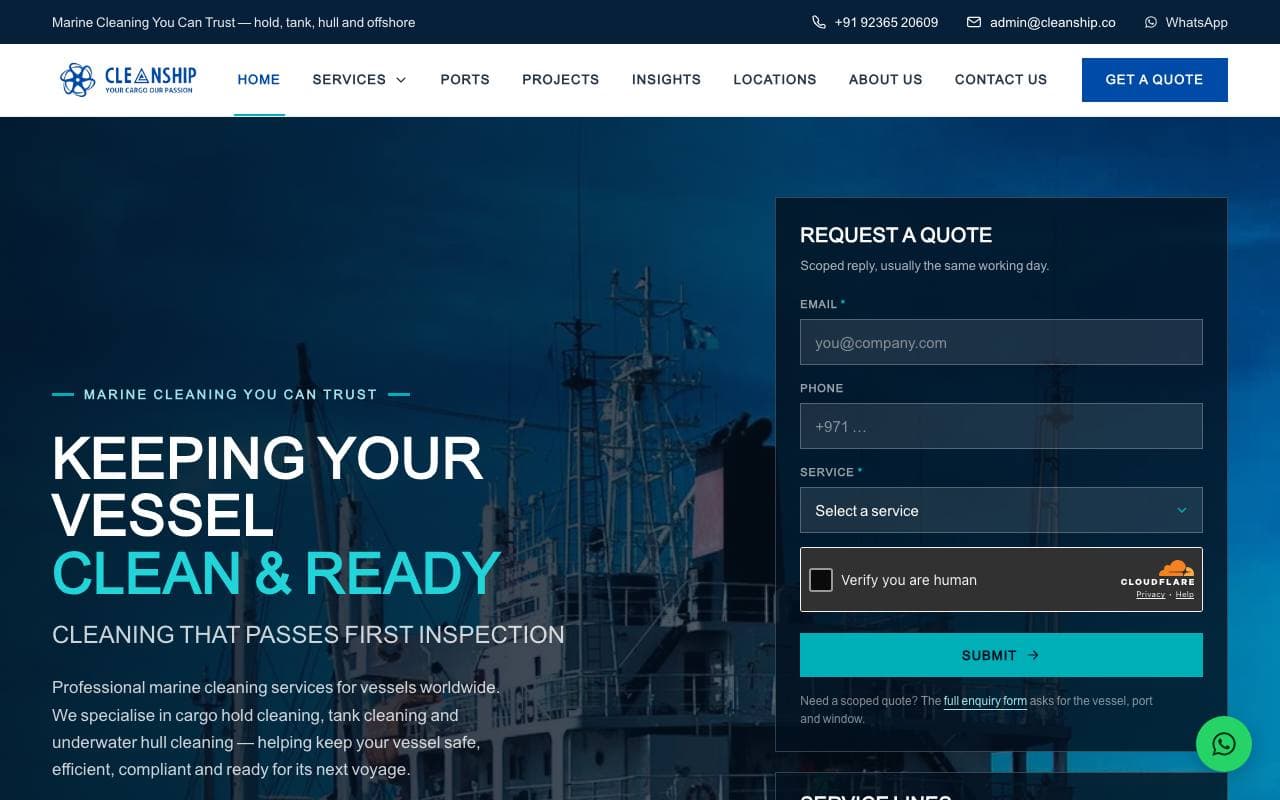
- Cleanship, a Next.js site with 310 service-and-port landing pages for a marine cleaning company, covering 13 UAE ports alongside ports in India, the Gulf and West Africa.
- MariBiz.ai, a global B2B marine procurement marketplace with 3,226+ vendors onboarded, an RFQ system, vendor verification and real-time messaging.
Our website development services page explains how we run projects. If you're comparing markets, our guides to hiring an Indian web team from the USA and hiring an Indian web team from Singapore cover the same questions for those countries.
When is an Indian team the wrong call?
- You need someone on site, or regular face-to-face workshops.
- You need live collaboration through your whole working day.
- You handle sensitive personal information and can't keep it away from the development team.
- A contract, for example with government, requires data to stay onshore or be accessed only from Australia.
- Nobody on your side has time to write a brief and review progress each week.
Frequently asked questions
What is the time difference between Australia and India?
India is 2.5 hours behind Perth all year and 4.5 hours behind Brisbane. Sydney, Melbourne, Canberra and Hobart are 5.5 hours ahead of India during daylight saving and 4.5 hours ahead the rest of the year. Adelaide is 5 hours ahead in summer and 4 hours ahead in winter.
Do I pay GST on an Indian developer's invoice?
If you're GST-registered and the work is for your business, GST generally doesn't apply, provided you give the supplier your ABN and state that you're registered. The reverse charge applies if you couldn't claim a full GST credit. If you're not registered, GST applies, so check with your accountant.
Can an overseas developer access my customer data under the Privacy Act?
If the Privacy Act covers you, yes, but only after reasonable steps under APP 8, usually an enforceable contract, and you remain accountable for the developer's handling of it. Building and testing on anonymised staging data avoids most of the risk.
Who owns the website and the code?
You should, but only if the contract says so. Make sure it assigns copyright in the code and designs to your business in writing, and keep the domain, hosting, payment and analytics accounts in your name from day one.
How much does it cost to hire an Indian web team from Australia?
It depends on the platform, the number of page templates, integrations, content readiness and support after launch. We don't publish prices. Send us your brief and we'll reply with a fixed written quote in Indian rupees.
Conclusion
For an Australian business that can work from written feedback, keep customer data off the development environment and get copyright assigned in writing, an Indian team is a practical choice, with a few hours of overlap each afternoon. If you need people on site or onshore data access, hire locally. Message us on WhatsApp at +91 73482 28167 and you get a fixed written quote within one working day.