
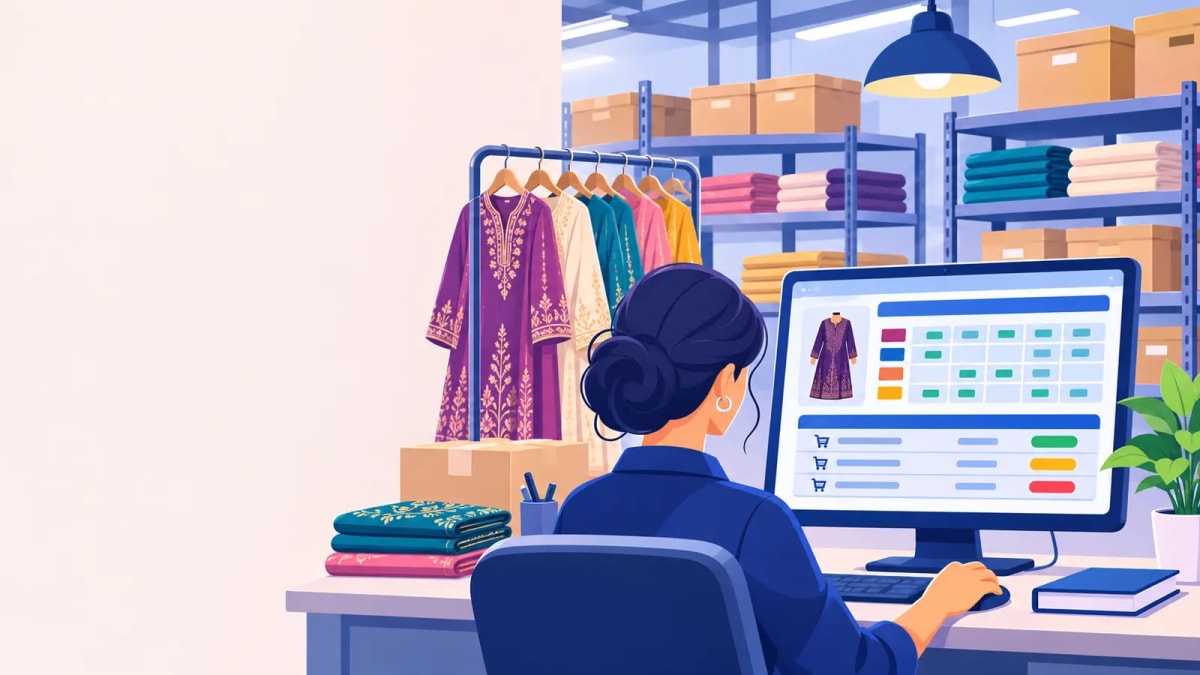
Ready-made software for a clothing business, or your own?
Plenty of billing, POS and ERP products serve garment shops and apparel brands, and many of them are good. Choose one if your business fits it: a single store, a standard catalogue, one or two sales channels. Custom software earns its cost when:
- Your catalogue is unusual. Made-to-order pieces, customisable blouses, sets sold together and separately, unstitched fabric sold by the metre alongside ready-to-wear.
- You sell on many channels and need one stock count that every channel reads from, in real time.
- You make what you sell. Fabric, dyeing, embroidery and tailoring happen in your own workshop or with job workers, and you need to know where every piece is.
- Your returns and exchanges are complicated. Exchanges for a different size, store credit, alterations, partial refunds on sets.
- Off-the-shelf tools are already stacked up. A POS, an inventory app, a marketplace connector and spreadsheets, with staff copying data between them every day.
What we build into fashion software
Product and variant management. One master catalogue with styles, colours and sizes as a variant matrix, fabric and care details, images and size charts. A new style with six sizes and four colours is created once, not twenty-four times, and pushed to every channel.
Stock by size, colour and location. Real-time stock for every variant in every location: warehouse, store, exhibition, job worker. When a piece sells anywhere, every channel updates. Low-stock alerts are set per size, because a brand usually runs out of mediums long before extra-large.
Orders from every channel in one place. Website, marketplaces, retail store, WhatsApp and phone orders flow into a single order list with one picking and packing process. Where a marketplace or platform offers an API, orders arrive automatically; where it does not, we provide a fast import.
Production and job work. For brands that make their own clothes: fabric received, cut, sent to dyers, embroiderers or tailors, received back, checked and moved into stock, with quantities and dates at every step. You see which job worker has how many pieces and which are late. This is where a fashion brand's money is tied up, and where spreadsheets lose track.
Made-to-order and alterations. Measurements, customisation notes and promised dates for bridal and couture orders, with status updates through production and a reminder before the delivery date.
Returns, exchanges and quality checks. Returns logged with reasons, items checked and graded back into stock or set aside, exchanges and store credit handled, and return reasons reported by product, so you can see which style has a sizing problem.
Purchasing and fabric stock. Fabric and trims bought from suppliers, stock by metre or unit, and reorder points, so production does not stop for want of lining.
Pricing, offers and members. Price lists by channel, member-only prices, festive offers and coupons, managed in one place.
Reports that matter to a fashion owner. Sell-through by style, size and colour; ageing stock; return rates by product; margin after returns and shipping; best and worst channels. These answer the questions that decide the next collection.
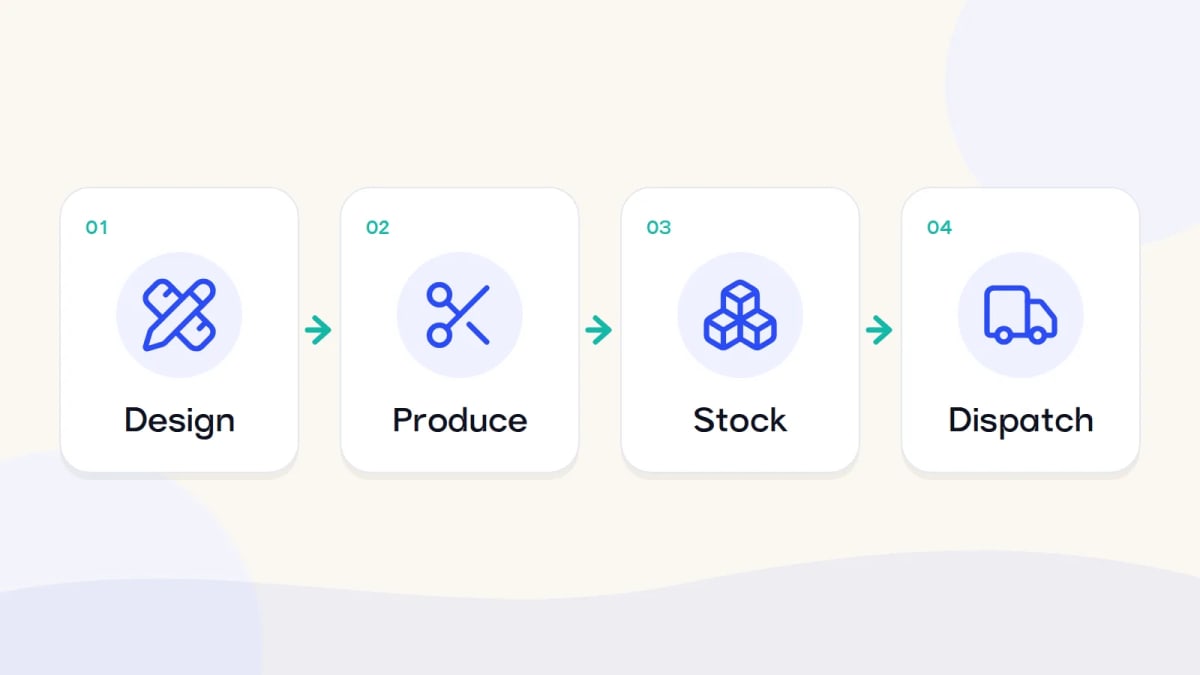
A typical flow, from design to dispatch
| Stage | What happens | What the software records |
|---|---|---|
| Design | Style created with sizes, colours and fabric | Style card, variant matrix, planned quantity |
| Produce | Fabric cut and sent to job workers | Pieces issued, job worker, expected return date |
| Stock | Finished pieces checked and received | Stock by variant and location, rejected pieces |
| Sell | Orders arrive from website, marketplaces, store, WhatsApp | One order list, stock updated everywhere |
| Dispatch | Picked, packed and shipped | Courier, tracking, invoice |
| Return | Item returned or exchanged | Reason, condition, back to stock or set aside |
Connecting to your store and the tools you already use
Your website stays where it is. If you sell on Shopify, WooCommerce or a custom store, the software connects to it through its APIs, so products and stock flow out and orders flow in. We also connect courier aggregators for shipping labels and tracking, payment gateways for reconciliation, WhatsApp Business messaging for order updates, and your accounting software where it offers a supported route, with GST set up the way your accountant advises. We confirm what each tool supports during discovery, before you commit.
On the shop floor and in the warehouse
Stock software only stays accurate if it is easy to use where stock moves. We generate barcode labels for every variant, so receiving, picking, store sales and returns are a scan rather than a search. Warehouse and workshop screens work on low-cost Android phones and tablets in a browser, with big buttons and few steps. For a retail counter, the same system can run billing so that a store sale and an online sale come off the same stock.
Planning for festive peaks and drops
Fashion sales in India are not even through the year. Wedding season, Diwali, Eid, Raksha Bandhan and end-of-season sales can bring several weeks of orders into a few days, and a limited drop can sell out in an hour. Software built for an average day breaks on those days. We design for the peak: stock is reserved the moment a customer pays, so the same last piece is not sold twice on two channels; marketplace stock buffers can be set per style before a sale, so a marketplace does not oversell what the website has already taken; packing screens batch orders by product to speed up picking; and courier pickups are booked in bulk. Before your biggest season we review the previous year's peak with you and test the system with that volume, rather than discovering the limits on the busiest day of the year.
Signs your stock data cannot be trusted
Most brands that come to us already suspect their numbers are wrong. The usual signs are:
- Orders cancelled after payment because a size turned out to be out of stock.
- Physical counts that never match the system, with the difference written off each quarter.
- Pieces "lost" at job workers, found months later or never.
- Sale decisions made on gut feeling because nobody trusts the sell-through report.
- Staff keeping their own private spreadsheet because the official stock is unreliable.
Each of these has a cause in how stock moves, not in people. The fix is to record every movement at the moment it happens, by scan where possible, so that the system and the shelf agree without heroic month-end counts.
Data, access and ownership
Each person sees what their job needs: the workshop sees production, the store sees its stock and sales, accounts sees money, and the owner sees everything. Every stock adjustment and price change is logged with who did it. Data is backed up, and it belongs to your business; the code is handed over with documentation.
How we build it
- Walk the business. We follow a style from design to dispatch and a return back to stock, at the workshop, the warehouse and the store, and list every spreadsheet and notebook involved.
- Pick the first release. Usually the catalogue, multi-channel stock and orders, because that is where money leaks; production and reports follow.
- Design and rules before code. Screens and plain-language rules, such as which channel gets stock first in a drop, approved by the people who will use them.
- Build in working slices. Each slice goes into a review environment with your real catalogue.
- Count and migrate. A stock count, product data cleaned and imported, open orders moved across.
- Launch and support. A launch outside your busiest season, training for each role and support in the first weeks.
A typical stack is React or Next.js with TypeScript, Node.js APIs and PostgreSQL, with Supabase for managed database and sign-in where it fits. A fashion shopping app can read from the same stock. We document the choice and the reason in the quote.
Proof: our fashion store work (direct fashion work)
- Tatvivah Trends. A Next.js multi-vendor marketplace for ethnic wear with 3000+ products, verified sellers, occasion-based filtering, Razorpay payments and a 10-day returns system: the catalogue, seller and returns logic a fashion back office runs on. Read the case study.
- Vashtara Heaven. A Shopify kidswear marketplace where each designer studio dispatches directly, so the store had to make a multi-vendor shipping model clear to buyers before checkout. Read the case study.
- Samaraha. A WooCommerce store for silk sarees with advanced filtering, member-exclusive pricing, promotional offer management and multi-gateway payments. Read the case study.
- Mahhika. A WooCommerce wedding-fashion store with bridal and festive collections, dynamic pricing and a promotional offer system. Read the case study.
What affects the cost
We do not publish prices. The main factors are the number of channels and locations, production and job-work tracking, made-to-order flows, returns rules, integrations with your store, marketplaces, couriers and accounting, barcode and POS needs, and the data to migrate. You get a fixed written quote within one working day of a clear brief, milestone approvals and a 50% advance to start.
Case studies
Case study · E-Commerce / Wedding Fashion
TatVivah Trends
Premium ethnic wedding wear marketplace with 3000+ products, verified sellers, and occasion-based filtering.
Read the TatVivah Trends case studyCase study · E-Commerce / Kidswear
Vashtara Heaven
Multi-vendor kidswear marketplace on Shopify — denim co-ords and printed sets for girls and boys, dispatched direct from each designer.
Read the Vashtara Heaven case studyCase study · E-Commerce / Textiles
Samaraha
Sophisticated e-commerce platform for premium traditional silk sarees with advanced filtering and secure checkout.
Read the Samaraha case studyCase study · E-Commerce / Wedding Fashion
Mahhika
Indian wedding fashion e-commerce platform with premium saree and ethnic wear collections.
Read the Mahhika case study
Frequently asked questions
Which software is best for a clothing business?
For a single store with a standard catalogue, a ready-made billing or POS product is often enough. Custom software suits brands with many channels, their own production, made-to-order pieces or complex returns.
What is ERP in fashion?
Software that connects a fashion business's catalogue, stock, production, purchasing, orders and accounts in one system. We build the parts your business needs rather than a full suite you will not use.
Can it keep stock in sync across our website and marketplaces?
Yes. Every channel reads from one stock count by size, colour and location, and updates when a piece sells anywhere.
Can it track pieces at dyers, embroiderers and tailors?
Yes. Pieces issued to and received from each job worker are recorded with dates, so you see what is where and what is late.
Will it work with our Shopify or WooCommerce store?
Yes, through the platform's APIs, so products and stock flow to the store and orders flow back.
Can staff use it on phones in the warehouse?
Yes. It runs in the browser on low-cost phones and tablets, with barcode scanning for receiving, picking and returns.
Can you move our current product and stock data?
Yes. We clean and import your catalogue after a stock count and move open orders across before launch.