
Introduction
A UAE online store is not an Indian store with the currency changed. Buyers check out in dirhams, many still want to pay the courier in cash, prices are expected to include VAT, and half the audience may prefer to read in Arabic.
This is the checklist we work through on every UAE store brief, in the order the decisions have to be made.
1. Pick the platform by who runs the store
Shopify is the right choice when the people running the store are not technical and the catalogue is conventional: adding a product takes minutes and nobody updates plugins. WooCommerce suits a store with unusual product options that would each become a paid Shopify app. A custom-coded store is for when checkout speed and catalogue logic decide revenue. We have written a longer comparison of WooCommerce and Shopify; the reasoning holds in the UAE.
2. Choose a payment gateway that settles in AED
UAE stores usually take card payments through gateways that settle in dirhams to a UAE bank account, such as Network International, Telr, PayTabs, Checkout.com or Stripe. Buy-now-pay-later is common too, through Tabby and Tamara.
Choose by three things: which gateways your bank works with, how quickly you can be approved, and the fees on your average order. Start the application early. Gateway approval needs your trade licence and company documents, and it is the step most likely to delay a launch.
3. Plan for cash on delivery
Many UAE shoppers still choose to pay the courier. Cash on delivery lifts conversion and raises the number of orders that are refused at the door, so build the rules in from the start: a minimum order value for COD, a COD fee if your margins need one, and an order confirmation on WhatsApp before the parcel ships.
We use WhatsApp confirmation on Indian stores for the same reason; Krushi Doctor and ClickNGreet both run support through it.
4. Show prices with VAT included
UAE VAT is 5%, and consumers expect the price on the product page to be the price they pay. Set the store up with VAT-inclusive prices and a checkout that shows the VAT amount, and have your accountant confirm the invoice format before launch.
5. Build Arabic as a real second language
- Right-to-left layout. The whole page mirrors, not just the text: navigation, arrows, sliders and the product gallery.
- Product data in both languages. Titles, descriptions, size charts and policies, not only the interface.
- Separate URLs per language with hreflang tags, so Google shows the Arabic page to Arabic searchers instead of treating it as a duplicate.
- Native copy. Machine translation reads as machine translation to the people you are trying to sell to.
6. Shipping and couriers
UAE delivery is fast and buyers expect it to be. Connect the store to your courier so labels and tracking are generated from the order, not typed in by hand. On our rate card each third-party integration, a courier included, is priced separately; payment gateway integration is included in every store.
7. Make it fast on a phone
Most shoppers browse on a phone. Check the store on a mid-range phone on mobile data before launch, not on an office laptop, and treat Google's Core Web Vitals as a launch requirement rather than a later fix.
What a UAE store costs
| Package | WooCommerce or Shopify | Custom-coded |
|---|---|---|
| Standard | AED 150–180 | AED 1,910–2,200 |
| Premium | AED 230–260 | AED 3,060–3,520 |
| Custom functionality | AED 230–270 | AED 3,830–7,650 |
AED figures are approximate, at ₹96 to US$1 and the fixed rate of AED 3.6725 to US$1. Quotes are issued in INR. Gateway fees, courier charges and any Shopify plan are paid by you to those providers. Support after launch starts at ₹2,000 (about AED 80) a year. The full breakdown is on our Dubai cost guide.
Stores we have built
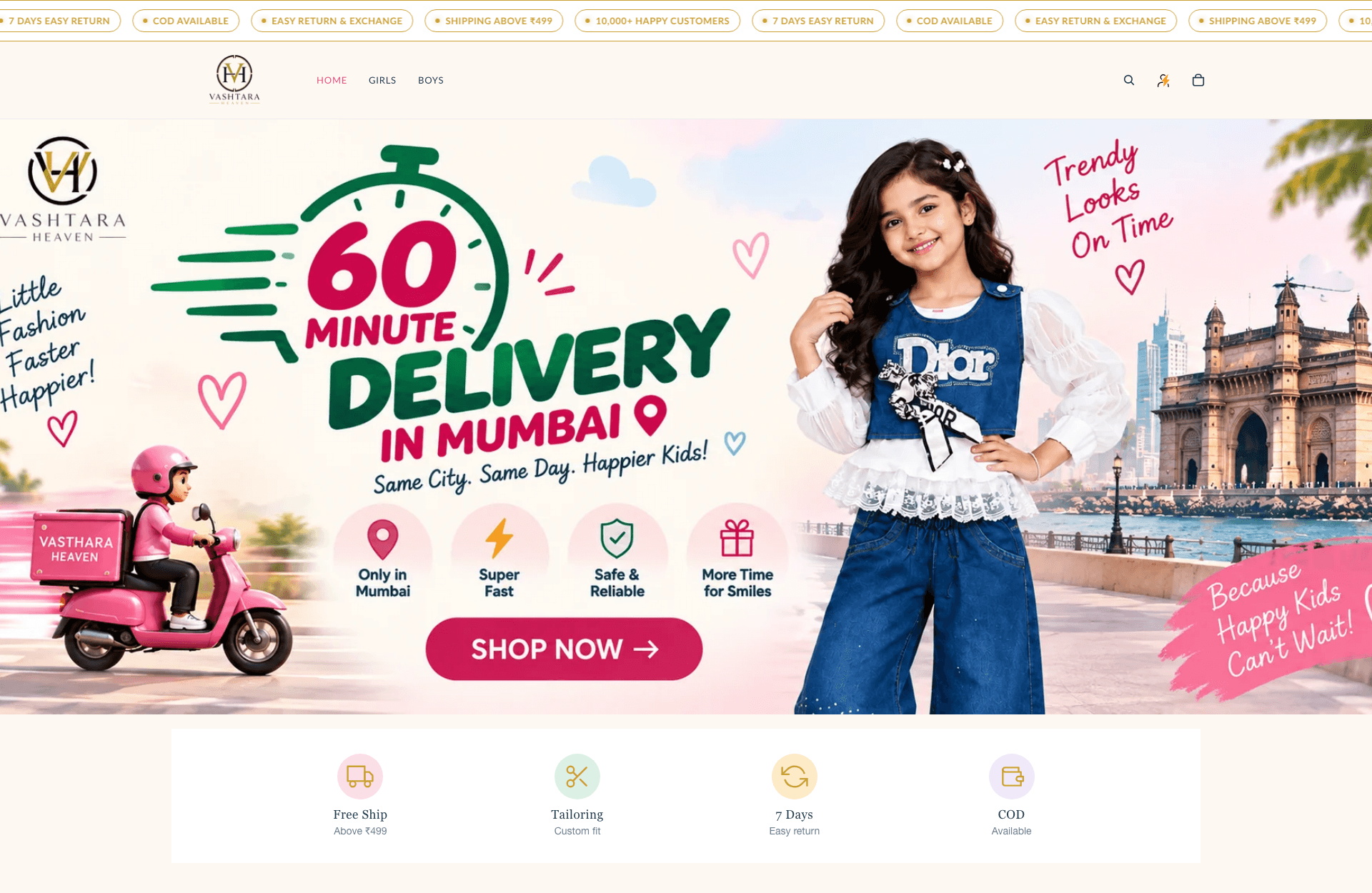
Vashtara Heaven is a Shopify store selling kidswear from several designer studios, each shipping its own orders, with cash on delivery nationwide and the split-shipment model explained before checkout. TatVivah Trends is a multi-vendor marketplace with more than 3,000 products and verified sellers. Both are Indian stores, and both solve problems a UAE store runs into on day one.
If you are building a store for the UAE, see website development for Dubai businesses, or message us with your catalogue size and the gateways your bank supports.
Conclusion
The platform is the easy decision. The work in a UAE store is the gateway approval, the cash-on-delivery rules, VAT-inclusive pricing and a real Arabic version, so settle those in the first week, not the last.