

Is it time for custom software or an ERP?
| Situation | Better fit | Why |
|---|---|---|
| Standard products, standard processes, budget for a long rollout | A manufacturing ERP | It covers most needs out of the box |
| Made-to-order or engineered-to-order work, each job different | Custom software | Job-based costing and planning rarely fit ERP templates |
| Accounting package works, but everything else is spreadsheets | Custom software connected to your accounts | Keep what works; replace the spreadsheets |
| ERP already in place, one painful process outside it | A custom module | Fix the gap without replacing the ERP |
If an ERP suits you, we will say so. Custom software is for factories whose way of working is part of what makes them competitive.
What we build
Enquiries and quotations. Customer enquiries logged with drawings and specifications, costing sheets that pull material and labour rates, quote versions and approvals, and a follow-up list so no enquiry is forgotten.
Sales orders and job cards. A confirmed order becomes a job card with the bill of materials, drawings, operations and due date, visible to everyone who works on it.
Production planning. Jobs scheduled on machines and work centres, with a live view of what is running, what is waiting for material and what is late. Supervisors update progress from a phone or a shop-floor tablet.
Material, stock and purchasing. Raw material, bought-out parts and finished goods by location, with reorder levels, purchase requests, supplier quotations and goods receipt against the order.
Quality checks. Inspection checklists at incoming, in-process and final stages, with measurements, photos and pass or fail recorded against the job, and test certificates generated for the customer.
Dispatch and documents. Packing lists, dispatch notes and delivery tracking, with invoices raised in your accounting software or exported to it.
After-sales service. Machines sold, warranties, service calls, engineer visits and spare-part orders tracked against each installed machine, connected to an app for field engineers when you have one.
Dashboards for the owner. Order book, on-time delivery, job profitability against the quotation, stock value and overdue payments, on one screen.
Connecting to the systems you keep
Most factories already use accounting software, often Tally, and do not want to change it. We connect to it through the routes your version supports, or exchange data files, so invoices and stock values agree without retyping. We also work with your existing drawings and part numbers, email, WhatsApp Business messaging for customer updates, and barcode or QR labels for stock. Machine data from PLCs or sensors can be brought in where the equipment offers a supported interface; we check during discovery before promising it.
Knowing what each job really earned
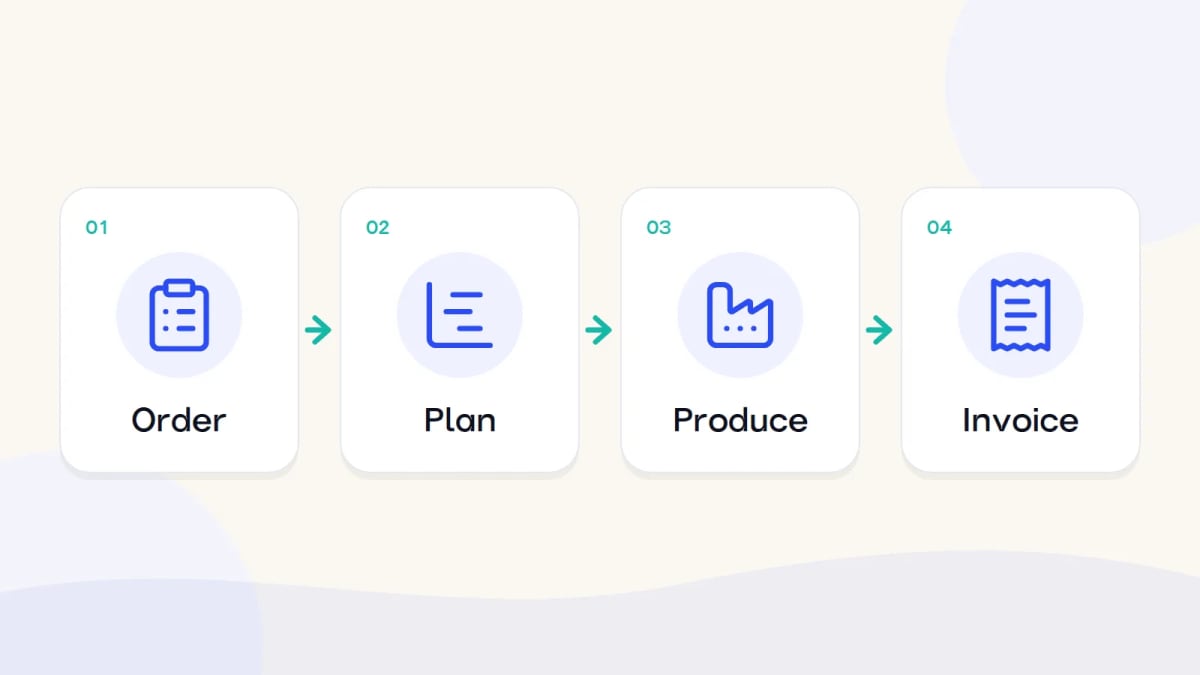
In made-to-order manufacturing, the quotation is a forecast and the job is the result. Most small and mid-sized factories never compare the two, because the actual material, machine hours, labour and rework are spread across store issues, attendance registers and supervisors' notes. When the software records material issued against the job card, time booked on each operation and rejections at inspection, it can show the actual cost of every job next to its quoted cost. Over a few months that comparison tells the owner which kinds of jobs make money, which customers' jobs always overrun, and which cost assumptions in the quotation sheet need to change. It is often the single report that pays for the system, and it needs nothing more than disciplined data entry on the shop floor, which is why we keep that entry as quick as a scan and a number.
On the shop floor
Software that supervisors will not use is worse than a whiteboard. We design shop-floor screens for gloves, noise and hurry: large buttons, few fields, a job found by scanning its QR label, and work that keeps going when the Wi-Fi drops at the far end of the shed. Hindi or the language your team speaks can be used for shop-floor screens while the office uses English.
How we build it
- Walk the factory. We follow one order from enquiry to dispatch, through the stores, the shop floor and the quality bench, and collect every form and spreadsheet used along the way.
- Pick the first release. Often enquiries, quotes and job cards, or production planning, depending on where delays cost you most.
- Design and rules on paper first. Screens and plain-language rules, such as how scrap is booked or who approves a quote below cost, approved by the people who use them.
- Build in working slices. Each slice goes into a review environment with your real jobs.
- Move the data. Item master, customers, suppliers, open orders and opening stock imported and checked after a stock count.
- Train and launch. Short training by role, launch at the start of a month, and support in the first weeks.
A typical stack is React or Next.js with TypeScript, Node.js APIs and PostgreSQL, with Supabase for managed database and sign-in where it fits. It runs in a browser on the computers, tablets and phones you already have. We document the choice and the reason in the quote.
Adjacent proof
- HCB Engineering (adjacent: a government-licensed electrical contractor, not a manufacturer). A WordPress website with service pages for commercial, residential and specialty work, a project portfolio and service-specific enquiry forms that capture project type, scale and timeline before the first call, the same enquiry data a quotation system starts from. Read the case study.
- MariBiz.ai (adjacent: a maritime procurement marketplace). A custom React and Node.js platform with an RFQ engine, vendor verification, a quote comparison dashboard and procurement analytics, the same building blocks as a factory's purchasing and supplier quotation module. Read the case study.
What affects the cost
We do not publish prices. The main factors are the modules you need first, the number of users and locations, integration with your accounting software, shop-floor devices and labels, quality documents, and the data to migrate. You get a fixed written quote within one working day of a clear brief, milestone approvals and a 50% advance to start.
Case studies
Adjacent work · another industry
HCB Engineering
Professional website for a government-licensed electrical contracting company with 20+ years of experience.
Read the HCB Engineering case studyAdjacent work · another industry
MariBiz.ai
Global marine procurement marketplace connecting 3,226+ vendors with shipowners across 121 service categories.
Read the MariBiz.ai case study
Frequently asked questions
What software is used in manufacturing?
Manufacturers use ERP, production planning, inventory, quality and maintenance software, often alongside accounting software. Custom software fills the gaps between them or replaces spreadsheets.
What are examples of custom software in a factory?
Quotation and costing tools, job card and production tracking, stock and purchasing, quality inspection records, dispatch documents and after-sales service tracking.
Will it work with Tally?
We connect through the routes your Tally version supports or exchange data files, so invoices and stock values agree. We confirm the method during discovery.
Can supervisors update production from the shop floor?
Yes, on a phone or tablet in the browser, finding a job by scanning its QR label.
Can it handle made-to-order and engineered-to-order jobs?
Yes. Each job carries its own bill of materials, drawings, operations and costing against the quotation.
How long does it take to build?
It depends on the modules. We agree the first release and its timeline in the fixed written quote, with milestone approvals.
Who owns the software?
Your company owns the code and data, and we hand over documentation with the project.