
Who this is for
- Structural steel fabricators and erectors.
- Sheet-metal and laser-cutting job shops serving other manufacturers.
- Custom fabricators making gates, railings, shelters and architectural metalwork.
- Metal finishing, galvanising and powder-coating firms.
- Small shops that have taken orders by phone for years and want serious inquiries.
What a fabricator's website needs
Capability by process. Cutting, bending, rolling, welding, machining, finishing and assembly each get a short, factual section: what the shop does, the thickness and size ranges it can handle, and the machines it has. A buyer scanning for "laser cutting up to 12 mm stainless" should find it in seconds. We only state ranges you give us.
Materials and finishes. Mild steel, stainless, aluminium and others, with finishing options such as painting, galvanising or powder coating where you offer them or have a partner who does.
Material documents. Steel buyers often ask for inspection documents. Under EN 10204, a type 3.1 certificate carries test results for the delivered material and is signed by the producer's inspection representative, who is independent of production; a type 3.2 certificate is additionally signed by the buyer's inspector or one named by regulation. If you can supply such documents with your material, saying so on the page helps the buyer. The project specification decides what is needed, so we describe what you can supply and do not claim more.
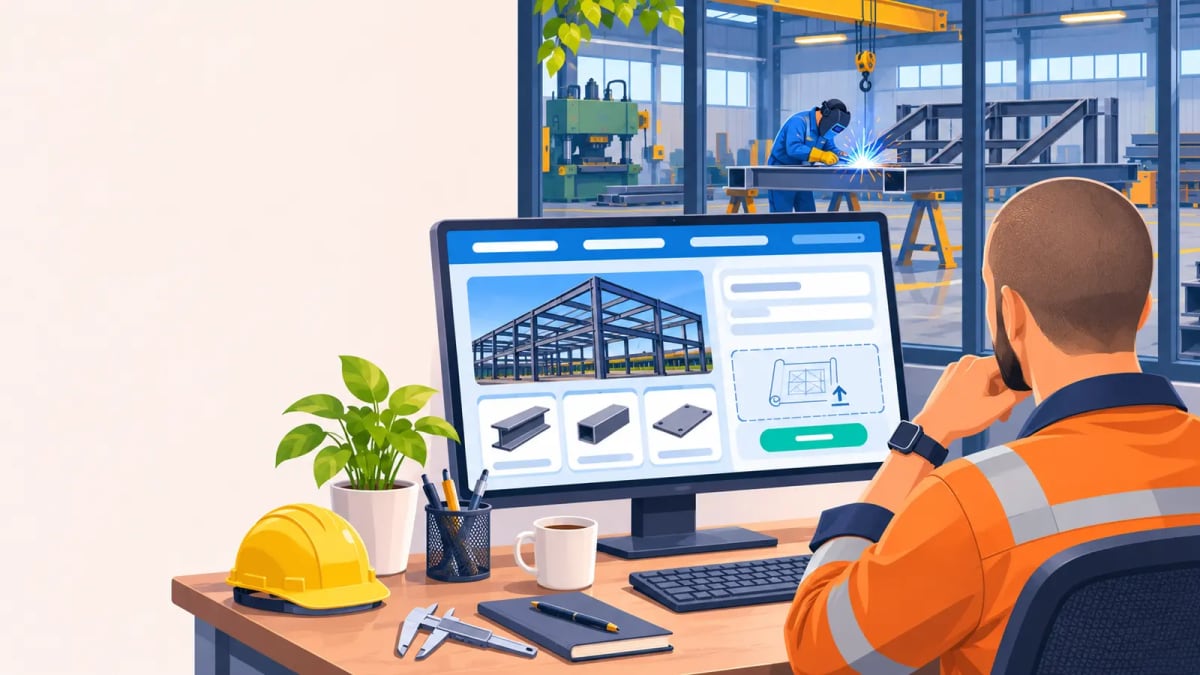
Drawing-based RFQs. An enquiry form that accepts drawings in common formats, with fields for material, quantity, finish, delivery location and required date. The form limits file types and size, and sends the files to a monitored address. For firms that want a quicker reply, we add a WhatsApp number for short questions.
Shop and equipment. Photographs of the actual floor, machines and finished work, with captions. Buyers can tell a stock-photo shop from a real one in seconds.
Quality and certifications. Quality-system certificates, welder qualifications and any third-party approvals, shown with issuing body and validity.
Project gallery. Fabricated items by type: structural frames, tanks, enclosures, conveyors, architectural metalwork. Each with a brief note on the material, size and your scope.
Delivery and capacity. A short statement of typical lead times and the largest piece you can handle, and a note on transport and loading.
Which fabricator website fits your shop
| Shop type | Typical buyer | What they check first | Pages we start with |
|---|---|---|---|
| Sheet-metal or laser-cutting job shop | Manufacturers and OEMs | Thickness and bed-size ranges, materials, lead time | Process pages, machine list, drawing upload RFQ |
| Structural steel fabricator and erector | Contractors, developers, industrial owners | Tonnage handled, erection capability, quality documents | Projects by structure type, capacity, certifications, tender enquiry |
| Architectural and custom metalwork | Architects, homeowners, builders | Finished photographs, finishes, site measurement process | Gallery by product type, standard designs, site-visit request |
| Finishing, galvanising or powder-coating firm | Fabricators and manufacturers | Bath or booth size, finishes offered, turnaround | Process pages, size limits, pick-up and drop-off details |

What decides the cost
The quote depends on how many process and product pages you need, whether the RFQ form handles large drawing files and routes jobs to different estimators, whether household buyers get a separate set of pages for gates, railings or sheds, how many finished projects we prepare for the gallery, and whether a simple price guide or configurator for standard products is part of the first phase. We list each item in the written quote.
How we build it
- Planning. We list your processes, machines, materials, typical orders and how RFQs are handled today.
- Content. You provide technical details; we structure and edit them and write the plain-language parts for buyers who are not engineers, such as homeowners ordering a gate.
- Design. Sturdy, readable and fast. Shop-floor photography leads.
- Build. WordPress with a custom theme for most shops, so your office can add a finished project in minutes; Next.js if you need a larger custom tool such as a quote configurator. The stack is stated in the quote.
- Forms and file handling. RFQ form with attachments, routed by type of work.
- Testing and launch. File uploads on mobile, form delivery, speed and every phone link.
Two kinds of buyer
A fabricator's site often serves an industrial buyer ordering batches of parts and a household buyer wanting a gate, a staircase railing or a shed. The first reads for tolerances and certificates; the second reads for price signals and photographs. We separate the two on the site, with distinct pages and forms, so each finds a clear path and neither gets drowned.
Proof: closest real work (adjacent)
We have no fabrication case study. The nearest work is labelled adjacent.
HCB Engineering is a WordPress corporate site for a government-licensed electrical contracting company with 20+ years of experience. It includes service pages for commercial, residential and specialty work, a project gallery, licence and certificate display, testimonials and several contact forms tied to service types. It is an electrical contractor, not a fabricator. Read the case study.
Mistakes we see
- A homepage that says "all kinds of fabrication work" with no process, material or size.
- Phone photographs of certificates, sideways and unreadable.
- An enquiry form with no way to attach a drawing.
- A gallery of finished items with no material, size or purpose.
- A site last updated before the shop bought its newest machine.
Turning an RFQ into a first reply
Fabricators lose orders by replying a day late. We design the enquiry flow around the first reply: the form tags the job by process, material and urgency, the email that reaches your estimator lists those fields at the top and a drawing is attached rather than linked. Your team can then reply within an hour with a clarifying question or a rough lead time. We also add a short acknowledgement message to the customer that sets expectations, such as when they will hear back and what you may need next, without promising a price.
Where you have a standard product, such as a gate model or a shelter design, we give it its own page with sizes and options, so a household buyer can choose without a call.
Quote and terms
We publish no prices. Share your processes and a sample drawing and a fixed written quote follows within one working day. Milestone approvals apply with a 50% advance to start, and a fabricator site normally takes 3–5 weeks from content sign-off.
Request a quote
Message us on WhatsApp at +91 73482 28167 with your processes, machines and a sample of the work you want more of, and you get a fixed written quote within one working day.
Case studies
Adjacent work · another industry
HCB Engineering
Professional website for a government-licensed electrical contracting company with 20+ years of experience.
Read the HCB Engineering case study
Frequently asked questions
Have you built a fabrication website?
No. Our closest work is HCB Engineering, an electrical contractor, which we label adjacent.
Can buyers upload drawings?
Yes, with limits on file types and size.
Can you build an instant price calculator?
That depends on your pricing rules and is a custom build, quoted separately.
Do you write the technical text?
We structure and edit what you supply. We do not state tolerances, materials or ranges you have not confirmed.
Can we show certificates?
Yes, with issuing body and validity.
Can the site help with local and industrial searches?
We set up structure, speed and local signals. No one can guarantee positions.
Can we sell standard products online?
That is an ecommerce build, quoted separately.
How long does a fabrication website take?
About 3–5 weeks from the day your process details, machine list and project photographs are signed off.