

Who this is for
- Civil and structural contractors who bid for private and government work.
- Interior fit-out and renovation firms that sell to homeowners and offices.
- Electrical, plumbing, HVAC and other trade contractors working under a main contractor.
- Family firms that grew on referrals and now need a presence that a stranger can verify.
What a contractor's website must prove
Capability by project type. A buyer wants "warehouse shell and core" or "three-storey residential", not "we do all construction". We organise the portfolio by project type, scale and your role, whether main contractor or sub-contractor. Each project page carries a location, a rough scope, the duration you can state and photographs from site.
Licences and registrations. Contractor licence class, GST registration, safety certifications and membership of trade bodies sit near the top, with the document number or a scan where you are comfortable showing it. For public-sector work this is often the first thing checked.
Equipment and crew. A short, honest page on in-house crews, machinery you own versus hire, and the size of project you can staff. It stops mismatched enquiries and reassures serious ones.
Site photography that tells the truth. Progress shots with dates beat polished renders. We structure galleries so that before, during and after images of one project stay together.
Enquiry routes by buyer. A homeowner asking for a bathroom renovation and a developer inviting a tender are different people. We give each a different form: the homeowner form asks for locality, scope and timing; the commercial form asks for drawings, bill-of-quantities availability and submission date, with an upload field.
Pages we plan for a typical contractor site
- Home: who you are, project types, licences and a clear enquiry button.
- Services: one page per trade or project type.
- Projects: filterable by type, city and scale, each with its own page.
- Credentials: licences, certifications and safety record where documented.
- Equipment and team.
- Contact and tender enquiries, with service-area notes.
- Blog or updates, optional, for notices about completed handovers.
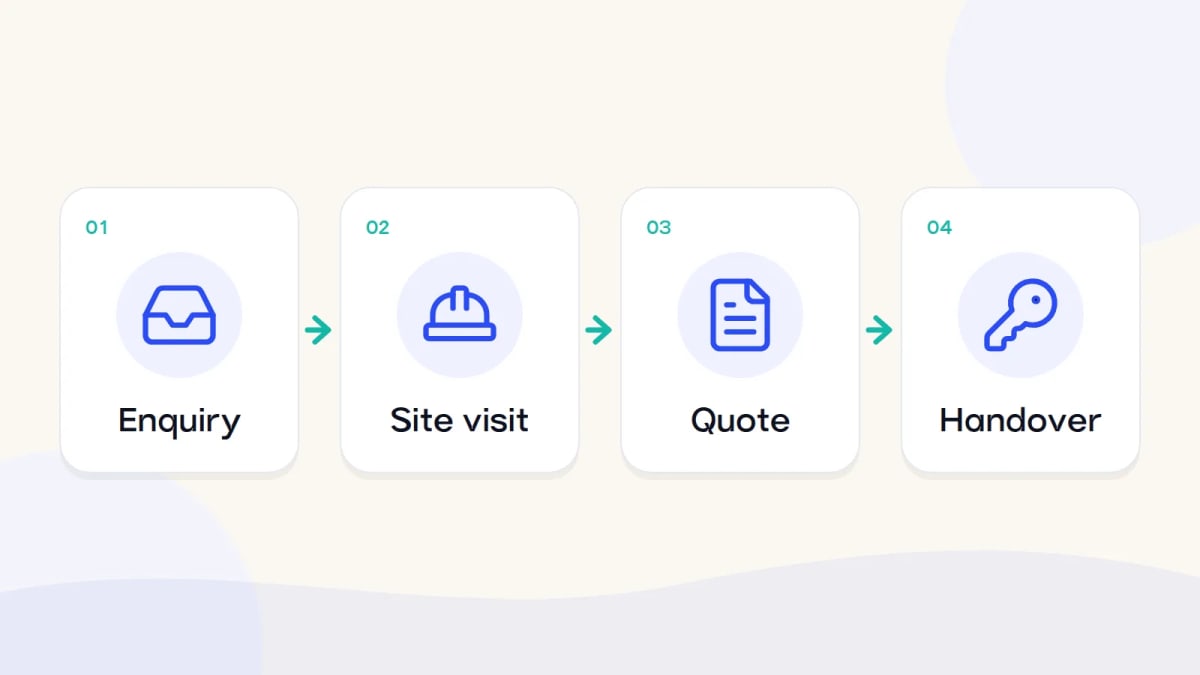
How we build it
- Content audit. We list the projects you can show, the permissions you have to name clients and the documents you can display. Many contractors discover they have strong material in WhatsApp folders.
- Structure. We map project types to pages so Google and a human both see where each belongs.
- Design. A sober, readable layout where photographs carry the weight. Large tap targets for site supervisors browsing on a phone.
- Build. WordPress with a custom theme is the usual choice, so your office staff can add a finished project in ten minutes. We use Next.js when a contractor needs something more custom, such as a client area. The stack is stated in the quote.
- Forms and routing. Enquiries go to email and, if you want, a WhatsApp number, tagged by type so the estimator sees tenders first.
- Testing and launch. Speed on mobile data, form delivery, image sizes, and every phone link. Training for whoever will update the projects page.
Proof: closest real work (adjacent)
HCB Engineering is a WordPress corporate site for a government-licensed electrical contracting company with over 20 years of experience. It has service pages for commercial, residential and specialty electrical work, a project portfolio gallery, a display of licences and certifications, client testimonials and several contact forms tied to service types. Its client was relying on referrals and was invisible to procurement officers searching online. This is an electrical contractor, so we label it adjacent for a general or civil contractor. Read the case study.
We do not have a case study for a civil or interior fit-out contractor.
Problems we see on contractor sites
- A portfolio of forty photographs with no captions, locations or project types.
- A licence mentioned in a footer line that says "licensed contractor" without a class or number.
- One contact form for everything, so tenders get lost behind homeowner requests.
- A site built on a free template that has not loaded on mobile since the last update.
- Text that says "quality and timely delivery" and nothing a buyer can check.
Writing project pages that buyers can use
A good project page names the building type, location and your scope in the first two lines. It then lists what you built, in the order a site engineer would describe it: foundation and structure, services, finishes. It gives the dates you can state and the size in square feet or metres, and it shows three to six photographs with captions. It says what was difficult, such as a tight urban site or monsoon timing, and how the team handled it. It avoids invented testimonials. If a client has agreed to be named, we link their name; if not, we describe them by type.
Safety and compliance content
Contractors who run a safety record can show it. A short page on your safety practices, toolbox talks, PPE policy and any certifications you hold helps with commercial buyers. We write this only from documents you give us and never state a certification you cannot produce. Rules on construction labour, contractor licensing and safety differ by state and by project type, so we ask you to confirm them with your own advisers rather than stating them on your behalf.
What to put on the page first
If a procurement officer reads only the first screen, it should show your trade, your city and your licence class, and one real project photograph. Everything else, including your history and your values, comes second. We design the top of each page around that rule.
Which contractor website fits your firm
The right site depends on who buys from you and how many projects you can document. This is how we usually scope it.
| Firm type | Main buyer | Pages we start with | What matters most |
|---|---|---|---|
| Renovation or interior fit-out firm | Homeowners and small offices | Services, 8–15 project pages, locality list, estimate request | Before-and-after photographs and a fast WhatsApp route |
| Trade sub-contractor (electrical, plumbing, HVAC) | Main contractors and developers | Trade pages, capacity page, project list by building type | Licences, crew size and the size of job you can staff |
| Civil or structural contractor | Developers, architects, public bodies | Project types, credentials, equipment, tender enquiry | Registration class, documented project scale, attachment-ready tender form |
| Multi-city or multi-division contractor | Mixed private and public buyers | Division pages, city pages written from real projects, careers | Clear routing so each enquiry reaches the right estimator |
What decides the cost of a contractor site
We publish no price list, because two contractor sites can differ by a factor of three. The quote depends on the number of project pages you can supply photographs and notes for, whether we write the service pages or edit yours, how many enquiry forms and routing rules you need, whether you want Hindi or another language alongside English, and whether a client or tender area with logins is part of the first phase. A site that starts with fewer, better-documented projects usually performs better than one padded with thin pages.
Quote and terms
We publish no prices. Share a brief and a fixed written quote follows within one working day. Payment runs in milestones you approve, starting with a 50% advance, and a contractor site normally takes 3–5 weeks from the day your photographs and documents are signed off.
Request a quote
Message us on WhatsApp at +91 73482 28167 with your trades, a few project photos and the kind of buyer you want to reach, and you get a fixed written quote within one working day.
Case studies
Adjacent work · another industry
HCB Engineering
Professional website for a government-licensed electrical contracting company with 20+ years of experience.
Read the HCB Engineering case study
Frequently asked questions
Have you built a site for a construction company?
We built one for an electrical contractor, HCB Engineering, which we label adjacent. We have not built for a civil or interior fit-out firm.
Can we upload tender documents or drawings?
Yes. The commercial enquiry form can accept attachments, and we limit file types and sizes to keep the inbox safe.
Will you write our project descriptions?
We structure and edit them from your notes and photographs. We do not invent project details, clients or figures.
Can we show government or public-sector clients?
Only if you are permitted to name them. Otherwise we describe the client type.
Can customers get a rough estimate on the site?
We can build a request form for an estimate. We do not recommend an automatic price calculator, because construction scope varies too much.
Can we add a client login for progress photos?
That is a custom build. We would scope it separately; see our custom software service.
How do I get a website built for my construction company?
Collect your licences, a list of projects you can show and their photographs, then send us your trades and target buyers. We return a written quote within one working day, and a typical contractor site takes about 3–5 weeks from content sign-off.
Do you promise first-page Google rankings?
No. We set up the structure, speed and local signals and no one can guarantee positions.